Defect Detection
Marked defects and material quality can be identified so unwanted areas are removed during the optimised cutting sequence.

Explore Salvamac semi-automatic docking saws, programmable crosscut systems and automatic optimising saws for accurate cut-to-length production, defect removal and faster timber processing.
Tuckwell Machinery supplies docking saws and crosscut saws for joinery workshops, timber processors, pallet manufacturers, furniture manufacturers, window and door producers and other woodworking businesses that need repeatable square cuts, safer material handling and consistent production.
The Salvamac range covers everything from the robust Legend 400, 500, 550 and 600 semi-automatic crosscut saws through to the programmable Combo system and the SalvaPush 2000 automatic optimising docking saw. Machines can be selected around timber section, cut length, required output, defect removal, automation level and available floor space, with Tuckwell supporting delivery, commissioning, operator training and ongoing technical assistance Australia-wide.
In Australian woodworking, the terms docking saw and crosscut saw are often used for the same basic job: cutting timber accurately across the grain to a required length. The key difference between machines is how much measuring, positioning, optimisation and material handling is automated.
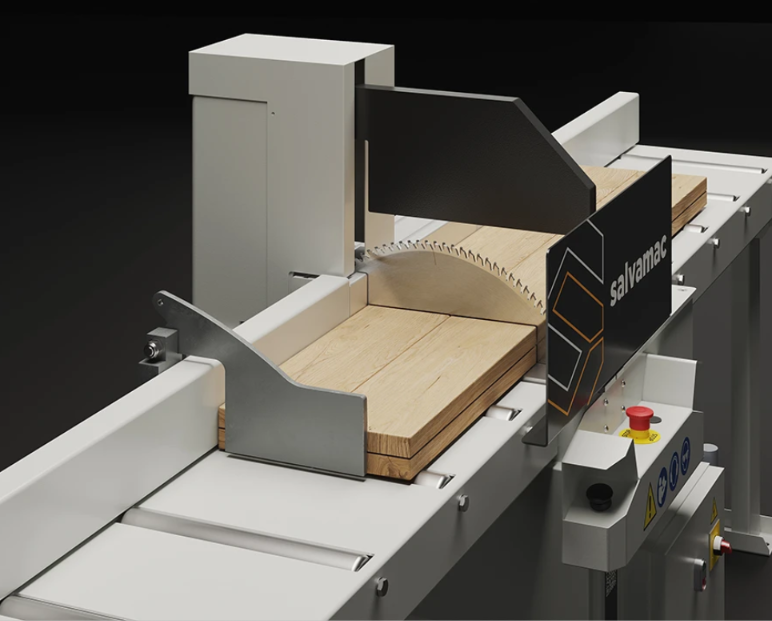
Semi-automatic up-cut saws for fast, safe square docking of small through to large timber sections.
View Legend models ↓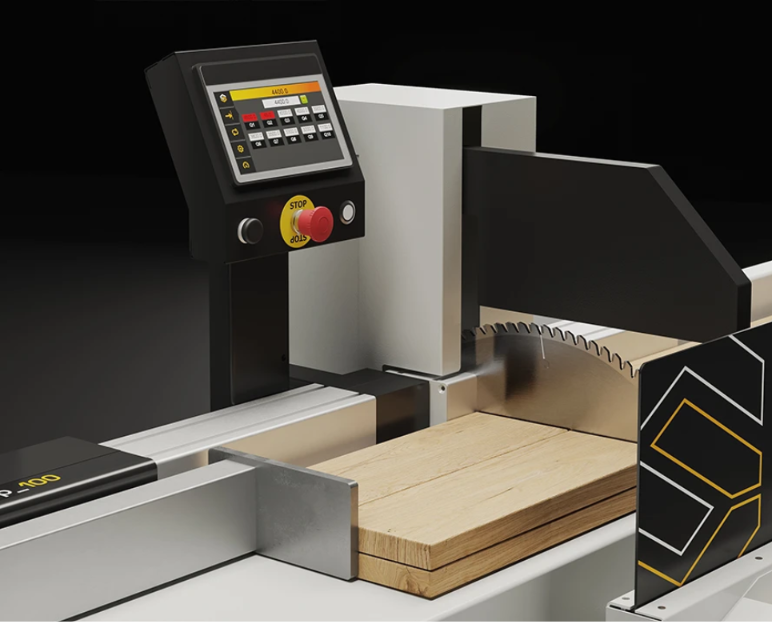
A programmable cutting station combining a Legend saw with electronic stop and positioning technology.
View the Combo ↓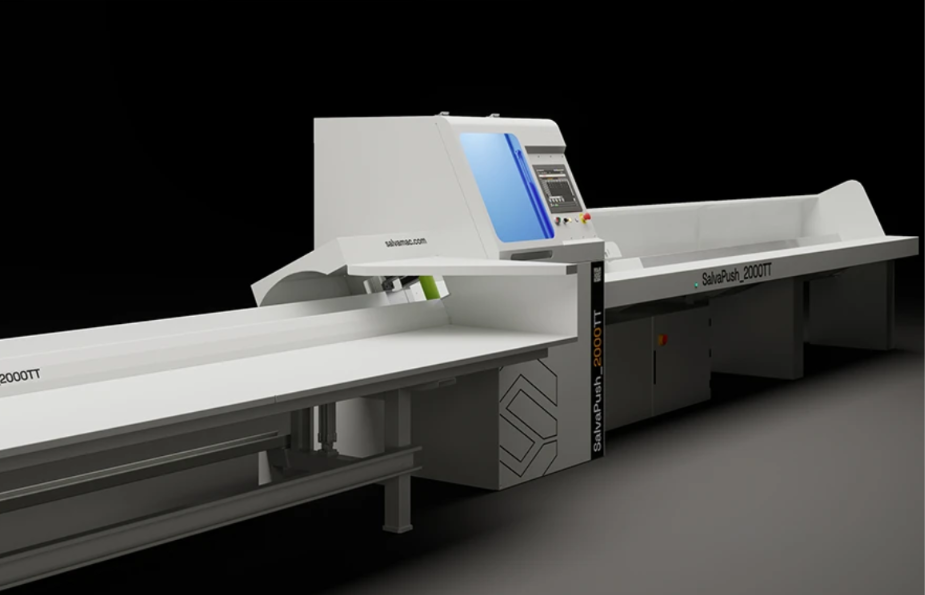
Automatic push-feed optimisation for cutting lists, marked defects, material yield and higher production output.
View SalvaPush ↓Salvamac Legend machines are heavy-duty semi-automatic crosscut saws built around reinforced painted-steel structures, pneumatic workpiece clamping and two-hand cut controls. The four models below step up in blade diameter, motor power and cutting capacity so the saw can be matched to the timber sections being processed.
| Specification | Legend 400 | Legend 500 | Legend 550 | Legend 600 |
|---|---|---|---|---|
| Blade diameter | 400 mm | 500 mm | 550 mm | 600 mm |
| Blade motor | 3.0 kW | 5.5 kW | 7.5 kW | 9.2 kW |
| Blade speed | 2,800 rpm | 2,800 rpm | 2,800 rpm | 2,750 rpm |
| Max cutting thickness* | 80 mm at 220 mm width | 125 mm at 220 mm width | 150 mm at 220 mm width | 150 mm at 420 mm width |
| Max cutting width* | 250 mm at 50 mm thickness | 310 mm at 50 mm thickness | 330 mm at 50 mm thickness | 610 mm at 30 mm thickness |
| Air consumption / cycle | 5 Nl | 7 Nl | 7 Nl | 14 Nl |
| Extraction ports | Ø120 + Ø100 mm | Ø120 + Ø100 mm | Ø120 + Ø100 mm | 2 × Ø140 mm |
*Cutting capacity changes according to the relationship between timber thickness and width. The examples above reflect Salvamac’s published maximum-section data.
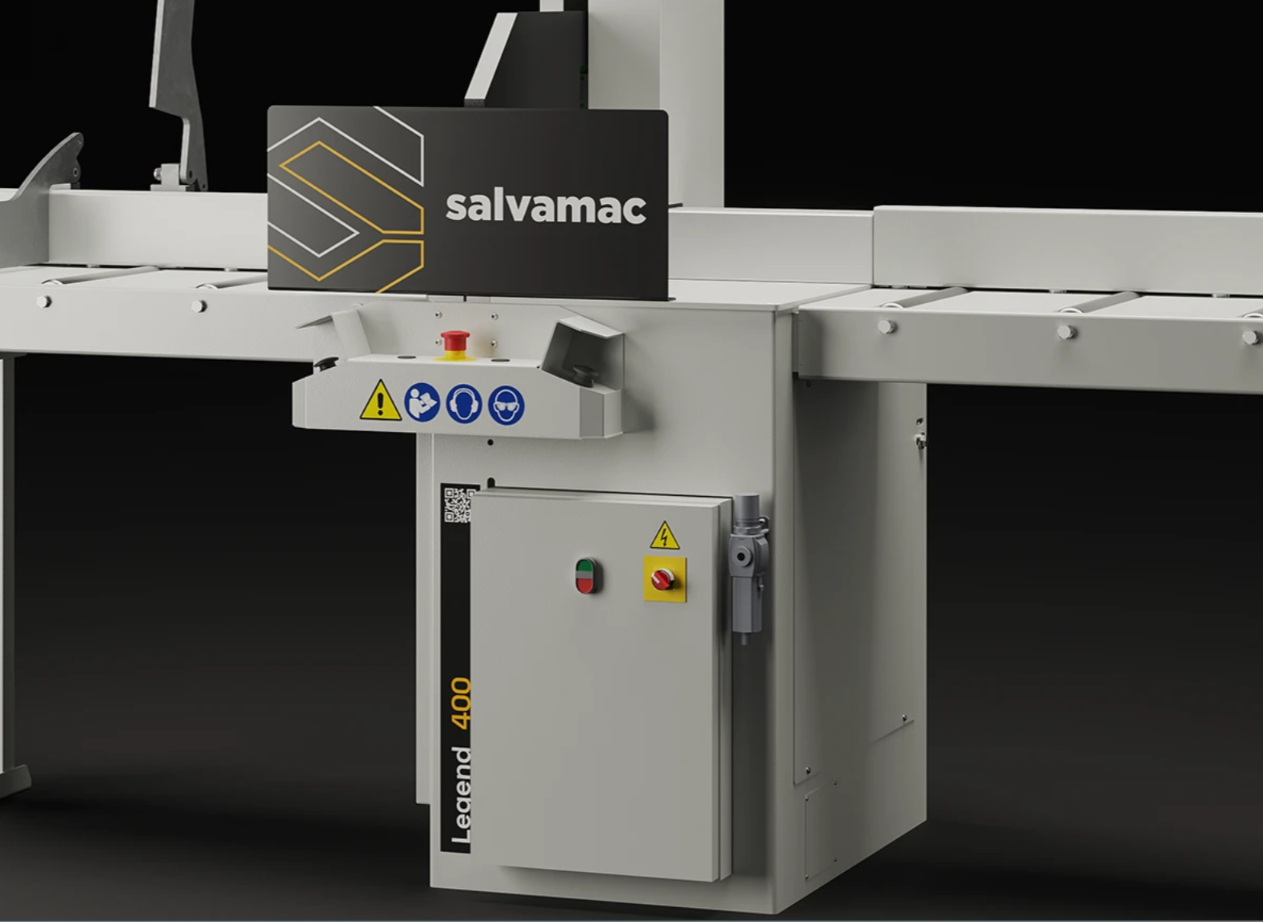
The Legend 400 is the entry point into the range for workshops cutting small to medium timber sections. Its 400 mm blade is driven by a 3.0 kW motor at 2,800 rpm, with published cutting capacity up to 80 mm thick or 250 mm wide depending on the workpiece profile.
It is suited to repetitive square docking where a workshop wants a more controlled and productive alternative to manual measuring and exposed cutting methods.
The Legend 500 increases capacity with a 500 mm blade, 5.5 kW motor and a maximum published cutting thickness of 125 mm at 220 mm width. At a 50 mm material thickness, the standard cutting width reaches 310 mm.
This makes the Legend 500 a versatile option for general joinery, furniture components, frame production, pallet and packaging work, and timber processing where medium sections are cut throughout the day.
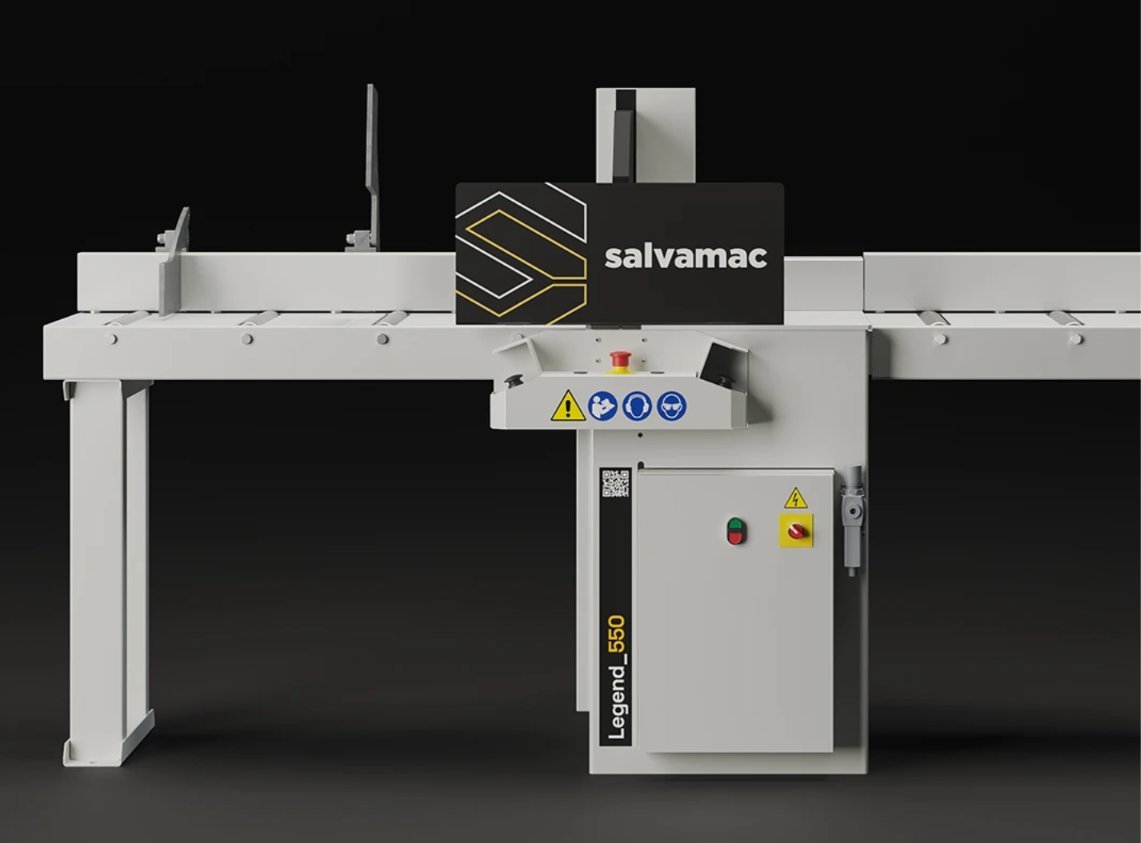
The Legend 550 is designed for medium to large timber sections. A 550 mm blade, 7.5 kW blade motor and 2,800 rpm spindle speed provide capacity up to 150 mm thick at 220 mm width, or up to 330 mm wide at 50 mm thickness.
It is a practical step up where the workshop regularly cuts heavier timber but does not require the very wide cutting capacity of the Legend 600.
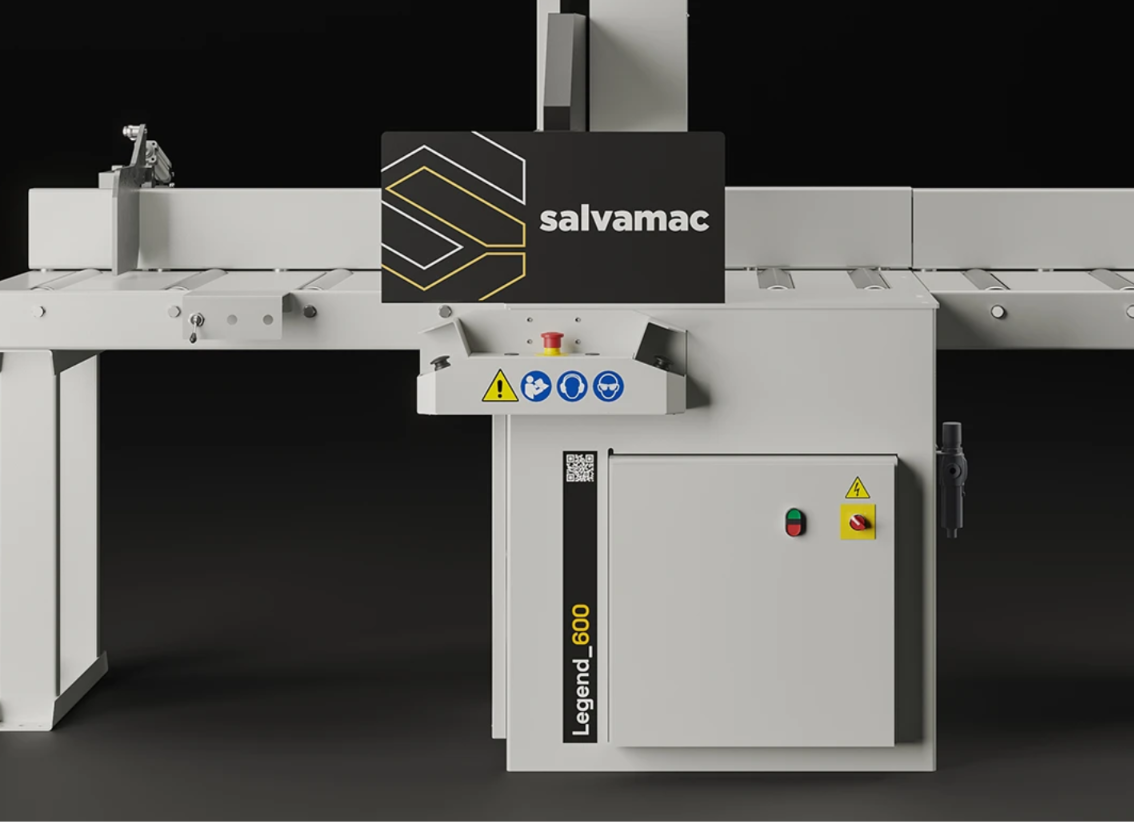
The Legend 600 is the largest model included on this page and uses a 600 mm blade with a 9.2 kW motor. Salvamac describes the machine as using a tilting blade movement for large sections, with published capacity up to 150 mm thick at 420 mm width and up to 610 mm wide at a 30 mm section thickness.
For timber processors, pallet manufacturers and businesses cutting wide structural or packaging components, the larger cutting window can reduce the need to move oversized work onto a separate saw.
The Combo moves beyond manual length setting by integrating a Legend semi-automatic crosscut saw with Salvamac’s SalvaStop electronic stop and positioning system. It is designed for workshops that want faster repeat cutting, fewer measuring errors and programmable cut-to-length production without moving to a fully automatic optimiser.
SalvaStop acts as an electronically controlled stop or pusher, allowing the operator to work from programmed dimensions rather than repeatedly reading a tape measure and moving a manual stop. Depending on configuration, the system can be used for one-off dimensions or stored cutting sequences.
A typical Combo 500 configuration uses the Legend 500 cutting unit, retaining its 500 mm blade, 5.5 kW motor and medium-section cutting capacity while adding programmable material positioning. For workshops comparing positioning and repeat-length options, Tuckwell also supplies saw stops and length measuring systems for accurate, repeatable cutting workflows.
The SalvaPush 2000 is designed for higher-output timber processing where the priority is not just cutting to length, but also optimising raw material, removing marked defects and automatically calculating the best combination of required finished lengths.
The operator marks timber quality and defects, while the SALVA-OPTIM control system calculates the cutting sequence. A laser photocell detects the board and a luminescence reader identifies fluorescent defect marks, allowing the saw to remove unwanted areas and use the remaining timber for the best available combination of programmed lengths.
Marked defects and material quality can be identified so unwanted areas are removed during the optimised cutting sequence.
The control calculates combinations of programmed lengths to reduce unnecessary offcut and improve raw-material utilisation.
Operators can view cutting statistics, results, diagnostics and machine information through the touchscreen interface.
The best machine depends on timber section, required throughput and how much of the measuring, positioning and optimisation process you want the machine to handle.
Salvamac crosscutting systems can be used wherever solid timber, profiles or components need to be docked accurately and repeatedly before the next stage of production.
Cut rails, stiles, frame components and solid-timber parts to consistent finished or pre-machining lengths.
Process repetitive timber components for pallets, crates, packaging and related high-volume cutting workflows.
Prepare timber profiles and components accurately before profiling, machining, assembly and finishing.
Dock rough or processed boards, remove faults and prepare feedstock for subsequent machining or production stages.
Cut production lengths for flooring, mouldings and other repetitive timber products where consistency is critical.
Use automated optimisation to combine required lengths, identify defects and improve yield from variable raw material.
Answer a few practical questions and the Tuckwell team can help narrow down the blade size, cutting capacity and level of automation that best suits your production.
Tuckwell Machinery helps Australian woodworking businesses select machinery around the real production task — not simply the largest machine on the specification sheet.
Recommendations based on timber section, cut length, volume, handling, defect removal and the next stage of production.
Help deciding whether a semi-automatic Legend, programmable Combo or full optimising system best fits your workflow.
Delivery coordination, installation, commissioning and operator training to help your team use the machine correctly.
Technician-backed assistance, maintenance support and help sourcing parts for machinery supplied by Tuckwell.
Tell us the timber sizes you cut, your current measuring process, required output and whether defects or multiple cut lengths are involved. We can help identify the most suitable Salvamac configuration.
Common questions about semi-automatic, programmable and optimising crosscut saws for timber processing.
A docking saw is used to cut timber across the grain to a required length, commonly at 90 degrees. In Australian woodworking, the term is often used for industrial crosscut saws used to dock boards, profiles and components before further machining or assembly.
For industrial timber machinery, the terms often overlap. “Crosscut saw” describes the cutting direction across the grain, while “docking saw” is commonly used in Australia for machines that trim or cut timber to length. The machine type, capacity and level of automation are more important than the terminology.
The main starting point is your maximum timber section. Legend 400, 500, 550 and 600 models progressively increase blade diameter, motor power and cutting capacity. Tuckwell can compare the actual width-and-thickness combinations you cut rather than selecting a machine from blade diameter alone.
The Combo adds SalvaStop electronic positioning to a Legend crosscut saw. This can reduce repetitive manual measuring, improve consistency and allow dimensions or cutting sequences to be programmed through the control rather than moving a manual stop for every cut.
An optimising saw calculates how raw timber should be cut to produce the required finished lengths while reducing unnecessary waste. Systems such as SalvaPush 2000 can also work with marked timber defects and quality classifications so unwanted areas are removed during the cutting sequence.
Yes. Salvamac describes a fixed reading system using a laser photocell for board presence and a luminescence reader for fluorescent marks. The operator marks defects or quality areas, and the optimisation software uses that information when calculating the cutting sequence.
Common users include joinery and furniture manufacturers, timber processors, pallet and packaging businesses, window and door manufacturers, flooring producers and workshops cutting repetitive solid-timber components.
Useful information includes your maximum and typical timber width and thickness, raw material length, finished cut lengths, cuts per shift, timber species, defect-removal requirements, current measuring method, available floor space and whether you need manual, programmable or fully optimised operation. You can contact Tuckwell Machinery to discuss the application.
Explore additional machinery for timber sizing, machining, planing, ripping, panel processing, dust extraction and complete woodworking production workflows.