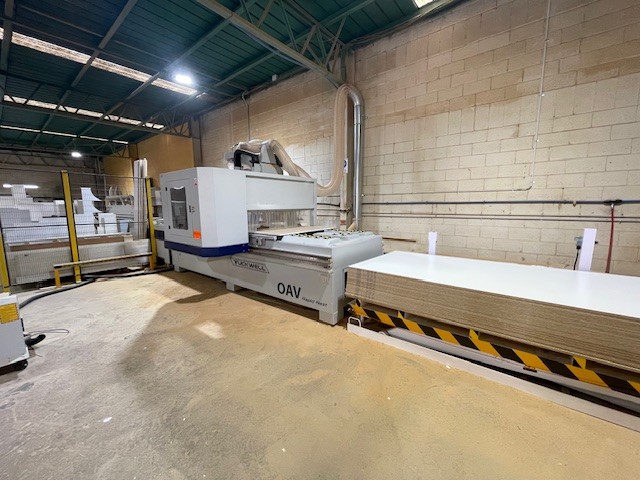
If you’ve been around the cabinet making or joinery industry for a while, you’ve probably heard CNC machines referred to as “point-to-point machines”.
It’s a term that still gets used today — but in reality, modern CNC woodworking machines have evolved well beyond traditional point-to-point systems.
If you’re researching machinery options, it’s worth exploring a full range of CNC wood router machines in Australia to understand what modern equipment can offer your workshop.
In this guide, we’ll break down what a point-to-point machine actually is, why the term still exists, and how it compares to today’s CNC wood routers.
What Is a Point-to-Point Machine?
A point-to-point (PTP) machine is a type of CNC machine that moves between fixed coordinates to perform specific operations such as drilling, boring or routing.
Instead of cutting along a continuous path, the machine:
- Moves to a set position
- Performs an operation (such as drilling a hinge hole)
- Moves to the next programmed point
These machines were traditionally used for:
- Line boring
- Hinge drilling
- Dowel hole drilling
- Basic routing tasks
They became extremely popular in cabinet making workshops due to their speed and accuracy for repetitive work.
Why the Term “Point-to-Point” Is Still Used
Even though technology has advanced significantly, many tradespeople still refer to CNC machines as point-to-point machines.
This is largely because earlier CNC machining centres were primarily designed for drilling and simple operations. Over time, the terminology stuck — even as machines became far more advanced.
Today, the term is often used loosely to describe:
- CNC machining centres
- Pod and rail machines
- CNC machines with drilling banks
However, modern machines offer much more functionality than traditional point-to-point systems ever did.
Point-to-Point Machines vs CNC Wood Routers
If you’re considering investing in machinery, it’s important to understand the difference between traditional point-to-point machines and modern CNC routers.
Point-to-Point Machines
- Best suited for drilling and boring operations
- Typically process one part at a time
- Use vacuum pods to hold individual components
- Work well with beam saws
- Ideal for repetitive, high-volume production
Modern CNC Wood Routers
- Handle full machining processes including cutting, drilling and shaping
- Can process full sheets using nesting
- Allow continuous toolpaths and complex designs
- Reduce manual handling and labour
- Improve material yield and efficiency
Modern CNC routers are designed to streamline production and give workshops far greater flexibility compared to traditional point-to-point systems.
Why Many Workshops Are Moving to CNC Routers
Increased Efficiency
CNC routers can machine entire sheets in one setup, reducing handling time and speeding up production.
Labour Savings
With less manual positioning and setup required, CNC routers help reduce labour costs and improve workflow efficiency.
Material Optimisation
Nesting software allows for better sheet utilisation, reducing waste — which is especially important with rising material costs.
Greater Flexibility
From custom cabinetry to large production runs, CNC routers can handle a wide range of applications in a single machine.
Do Point-to-Point Machines Still Have a Place?
Absolutely. In the right environment, point-to-point machines can still be a valuable part of a workshop setup.
They are particularly useful for:
- High-volume cabinet production
- Workshops already running beam saw workflows
- Operations focused heavily on drilling and hardware preparation
Many larger operations actually run both systems together — using point-to-point machines for repetitive drilling tasks and CNC routers for cutting and custom work.
Choosing the Right Machine for Your Workshop
The best machine for your business depends on your workflow and production goals.
A point-to-point machine may suit you if you:
- Focus on repetitive, high-volume jobs
- Already use a beam saw
- Mainly require drilling and boring operations
A CNC router may be the better choice if you:
- Want to reduce labour and handling
- Produce custom or varied work
- Need full machining capability in one setup
- Are looking to improve efficiency and material usage
Work With Experts Who Understand Your Workshop
Tuckwell Machinery are experts when it comes to setting up your shop with the right woodworking equipment.
Our reputation has been built on “service, service, service”, and we are known for our outstanding after-sales service and support.
We don’t just sell machines — we help you choose the right solution for your workflow, and we’re there to support you long after installation.
Because Tuckwell Machinery was originally built around servicing and repairing woodworking machinery, our team understands the real-world production challenges cabinet shops face every day.
Final Thoughts
The term point-to-point machine is still widely used in the woodworking industry, but modern CNC technology has evolved far beyond its original definition.
Understanding the difference between point-to-point systems and CNC routers will help you make a more informed decision when investing in machinery.
If you’re planning to upgrade your workshop, choosing the right machine can have a significant impact on your efficiency, output and long-term profitability.